
Manufacturing Compliance & Cybersecurity Framework Support
Compliance Is an Infrastructure Problem
Before It Becomes an Audit Problem

Compliance Alignment for Modern Manufacturing
Manufacturing organizations are operating under increasing security and compliance pressure. Requirements that once applied primarily to large defense contractors or enterprise manufacturers are now affecting mid-sized fabrication shops, industrial suppliers, engineering firms, and production facilities throughout Texas.
Many manufacturers are now expected to demonstrate cybersecurity maturity before they can maintain customer relationships, qualify for contracts, renew cyber insurance policies, or participate in regulated supply chains.
At Preactive IT Solutions, we work with manufacturers across Houston and South Texas that need to align operational infrastructure, cybersecurity controls, and documentation practices with modern compliance expectations. Our approach is infrastructure-first and operationally grounded. We focus on building environments that support both production continuity and compliance readiness.
Manufacturing Compliance Is Becoming an Operational Requirement
Manufacturing cybersecurity is no longer driven solely by internal IT policy. Security expectations are increasingly being shaped by customers, insurers, supply chain partners, and government frameworks.
For many manufacturers, compliance now directly affects contract eligibility, cyber insurance renewals, and operational risk exposure. This is especially true across energy, engineering, fabrication, aerospace, and industrial manufacturing sectors throughout Texas.
At the same time, manufacturers are operating in increasingly connected environments that rely on real-time data, remote access, cloud-connected systems, and integrated production workflows. As infrastructure becomes more interconnected, operational and cybersecurity risks become more difficult to separate.
The impact is measurable across multiple industry studies.
| Compliance & Risk Area | Industry Finding | Source |
|---|---|---|
| Manufacturing Targeting | Manufacturing has become one of the most targeted industries for ransomware and operational disruption. | IBM X-Force Threat Intelligence |
| Downtime Cost | Unplanned downtime costs industrial manufacturers an estimated $50 billion annually. | Plant Engineering |
| Operational Dependency | Modern manufacturing environments are increasingly dependent on connected infrastructure and edge systems. | IBM Institute for Business Value |
| Insurance Requirements | Cyber insurers increasingly require MFA, EDR, backup validation, and incident response planning. | Coalition Cyber Insurance Reports |
| Supply Chain Compliance | Manufacturers supporting government or defense contracts increasingly face NIST 800-171 and CMMC expectations. | U.S. Department of Defense |

NIST 800-171 and DFARS Requirements for Manufacturers
Manufacturers supporting defense, aerospace, or government-adjacent supply chains increasingly encounter requirements tied to NIST SP 800-171 and DFARS 252.204-7012. These frameworks are designed to improve the protection of Controlled Unclassified Information, or CUI, within the Defense Industrial Base.
For manufacturers, this often introduces requirements related to:
- Access control and identity management
- Multi-factor authentication
- Logging and monitoring
- Endpoint protection
- Incident response procedures
- Secure remote access
- Configuration management
- Backup and recovery validation
Compliance is not achieved through policy documents alone. Controls must exist operationally within the environment. Many manufacturers discover that compliance initiatives expose broader infrastructure limitations that have accumulated over time.
Understanding CMMC Requirements
The Cybersecurity Maturity Model Certification, or CMMC, expands on existing defense cybersecurity requirements by introducing formal assessment expectations for contractors and suppliers.
Unlike traditional self-attestation models, CMMC places greater emphasis on evidence, repeatability, and operational consistency. Manufacturers may eventually need to demonstrate that required controls are actively implemented, monitored, and maintained across their environments.
This includes areas such as:
- Asset inventory and system visibility
- Access management and identity controls
- Vulnerability remediation
- Security awareness training
- Incident response planning
- Audit logging and retention
- Risk management processes
Organizations approaching CMMC readiness often discover that technical debt, inconsistent documentation, and fragmented infrastructure create significant obstacles to compliance maturity.

Compliance Starts with Infrastructure Maturity
Compliance frameworks depend on infrastructure stability, visibility, and enforceable controls. If systems are poorly segmented, inconsistently managed, or lacking centralized monitoring, compliance becomes difficult to sustain operationally.
Manufacturing environments often include a combination of legacy systems, unsupported operating systems, vendor-managed equipment, and production technologies that cannot easily tolerate aggressive change management. In many facilities, security modernization efforts are constrained by operational uptime requirements and limited maintenance windows.
As a result, manufacturers frequently struggle with inconsistent access controls, limited logging visibility, shared administrative access, and fragmented asset management. These limitations directly affect an organization's ability to align with modern cybersecurity frameworks and insurance requirements.
Core infrastructure maturity typically requires centralized identity management, secure remote access, network segmentation, endpoint visibility, backup validation, and continuous monitoring capabilities. Without these foundational controls, compliance becomes difficult to operationalize consistently.
Talk to Preactive IT Solutions
If your organization is evaluating NIST 800-171 alignment, CMMC readiness, DFARS cybersecurity requirements, or broader manufacturing compliance initiatives, Preactive IT Solutions can help assess your infrastructure, security controls, and operational risk exposure.
We work with manufacturers across Houston and South Texas that require infrastructure stability, cybersecurity maturity, documentation readiness, and operationally grounded compliance support aligned with real production environments.

Cyber Insurance Requirements Are Becoming More Aggressive
Cyber insurance underwriting requirements have changed significantly in recent years. Many insurers now require manufacturers to demonstrate baseline cybersecurity maturity before issuing or renewing policies.
Insurers increasingly evaluate whether organizations have implemented:
- Multi-factor authentication
- Endpoint detection and response
- Immutable or isolated backups
- Security awareness training
- Vulnerability management
- Administrative access controls
- Incident response planning
Manufacturers operating on outdated or inconsistent infrastructure often face higher premiums, fewer coverage options, increased underwriting scrutiny, or coverage exclusions tied to operational risk.
For many manufacturing organizations, cyber insurance has effectively become another external compliance driver.
Compliance in Manufacturing Requires Operational Alignment
Compliance initiatives frequently fail when security controls are implemented without considering production realities. Manufacturing environments operate differently from traditional office environments, and security strategies must account for operational continuity.
Production systems may depend on unsupported operating systems, legacy machinery, proprietary vendor software, or industrial equipment that cannot tolerate frequent interruption. In some facilities, even minor downtime windows require extensive operational coordination.
At the same time, manufacturers are expected to maintain documentation, evidence collection, and repeatable security processes that support audits, customer reviews, and insurance requirements. This includes maintaining asset inventories, access policies, backup validation records, incident response procedures, and vendor access documentation.
A technically secure environment that lacks operational consistency or documentation maturity may still struggle during assessments or contractual reviews.
This is why manufacturing compliance cannot be approached as a purely technical exercise. It requires alignment between infrastructure, operational processes, production realities, and security controls.
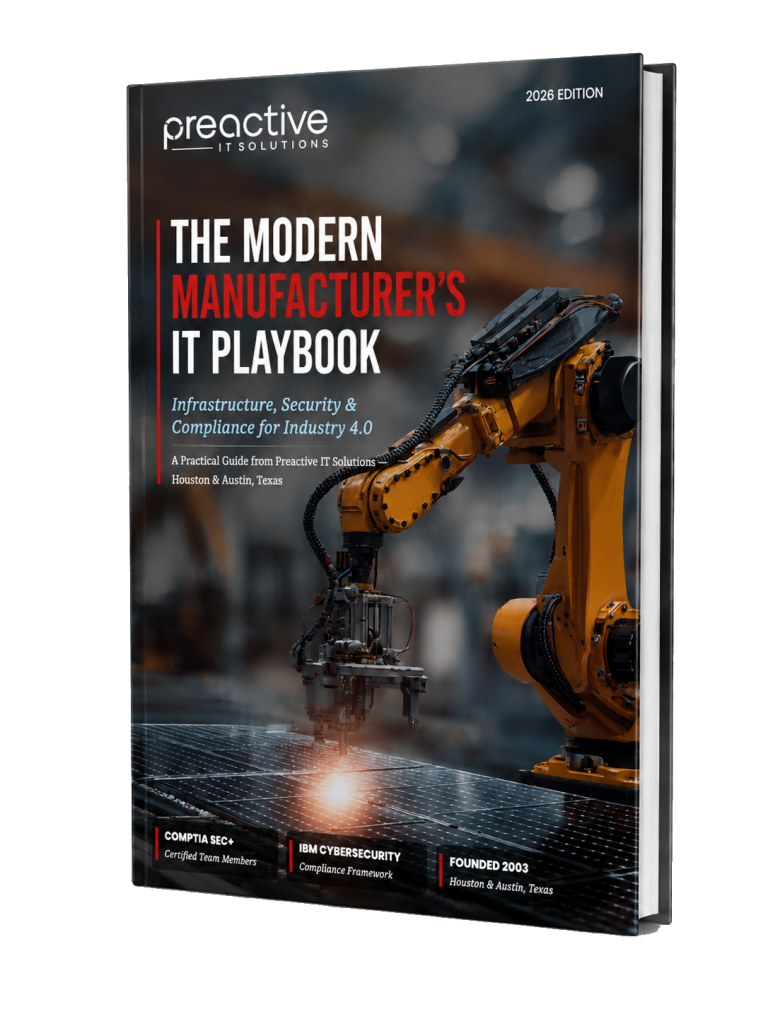
The Modern Manufacturer’s IT Playbook
Infrastructure, Security &
Compliance for Industry 4.0

Manufacturing in Houston and South Texas
Manufacturing organizations across Houston and South Texas support critical industrial sectors including energy, fabrication, engineering, logistics, and industrial supply chains.
These environments increasingly face pressure from vendor cybersecurity reviews, insurance requirements, operational resilience expectations, and government-related compliance obligations. As infrastructure modernizes, cybersecurity and compliance expectations are becoming more integrated with day-to-day production operations.
For many manufacturers, compliance readiness is now directly connected to long-term operational competitiveness.

Our Locations

Houston TX
Preactive IT Solutions, LP
1220 Blalock Road, Suite 345
Houston, Texas 77055
Phone: (832) 583-3707
Email: [email protected]

Austin TX
Preactive IT Solutions, LP
2505 E 6th St Suite C,
Austin, TX 78702
Phone: (512) 812-7227
Email: [email protected]

San Antonio, TX
Preactive IT Solutions, LP
700 North Saint Mary's Street, Suite 1210
San Antonio, Texas 78205
Phone: (210) 864-2929
Email: [email protected]

Beaumont, TX
Preactive IT Solutions, LP
985 I-10 St suite 103,
Beaumont, TX 77706
Phone: (409) 239-0004
Email: [email protected]
Manufacturing Compliance FAQs
What cybersecurity compliance frameworks apply to manufacturers?
Manufacturers may be required to align with several cybersecurity frameworks depending on their customer base, industry, and risk profile. The most common include the NIST Cybersecurity Framework (CSF), which provides general security guidance; NIST 800-171, which governs the protection of controlled unclassified information; and CMMC, which applies to manufacturers serving the defense industrial base. Cyber insurance providers also impose their own technical requirements as a condition of coverage, which increasingly mirror NIST and CMMC controls.
What is the difference between NIST CSF and NIST 800-171 for manufacturers?
NIST CSF is a voluntary framework that helps organizations identify, protect, detect, respond to, and recover from cybersecurity risks. It is broadly applicable and widely used as a baseline for security program development. NIST 800-171 is a more specific set of requirements focused on protecting Controlled Unclassified Information (CUI) in non-federal systems. Manufacturers that handle CUI — particularly those supplying the federal government or defense contractors — are typically required to meet NIST 800-171 controls, which are more prescriptive than the general guidance in the CSF.
What is CMMC and does it apply to my manufacturing company?
The Cybersecurity Maturity Model Certification (CMMC) is a framework developed by the U.S. Department of Defense to verify that defense contractors and their suppliers adequately protect sensitive government information. CMMC applies to any organization in the Defense Industrial Base (DIB) that handles Federal Contract Information (FCI) or Controlled Unclassified Information (CUI). If your manufacturing company holds or pursues DoD contracts — or supplies to prime contractors that do — CMMC requirements likely apply to your environment either directly or through contract flow-down requirements.
What does a manufacturer need to do to prepare for CMMC certification?
Preparing for CMMC certification typically begins with a gap assessment that compares your current security controls against the required CMMC level. From there, manufacturers need to document security policies and procedures, implement missing technical controls, address vulnerabilities identified in the assessment, and develop a System Security Plan (SSP). For CMMC Level 2, a third-party assessment organization (C3PAO) conducts the formal certification audit. Preparation timelines vary depending on the maturity of the existing environment, but most manufacturers require several months of remediation work before they are audit-ready.
What cybersecurity controls do manufacturers need to qualify for cyber insurance?
Cyber insurers have significantly tightened technical requirements over the past several years. Most carriers now require documented evidence of multi-factor authentication (MFA) on email and remote access, endpoint detection and response (EDR) tools, immutable or offsite backups tested for recovery, network segmentation, privileged access management, and a documented incident response plan. Manufacturers that cannot demonstrate these controls may face higher premiums, reduced coverage limits, or denial of coverage. Aligning with NIST CSF controls is one of the most effective ways to satisfy insurer requirements across multiple policy categories.
How do cyber insurance requirements overlap with NIST and CMMC frameworks?
Cyber insurance requirements and NIST/CMMC controls have significant overlap, particularly around access control, multi-factor authentication, endpoint protection, backup and recovery, and incident response. Manufacturers that have implemented NIST 800-171 or CMMC Level 2 controls are typically well-positioned to meet insurer requirements, since both frameworks require many of the same technical safeguards. This overlap means that compliance work done for regulatory or contractual purposes can directly reduce insurance premiums and improve coverage terms — and vice versa.
How does a managed IT provider help manufacturers meet compliance requirements?
A managed IT provider supports compliance by implementing and maintaining the technical controls that frameworks require — including endpoint protection, MFA, network segmentation, patch management, backup validation, and security monitoring. Beyond technical implementation, a provider experienced in manufacturing compliance can help document security policies, develop a System Security Plan, conduct gap assessments, and prepare for audits or insurance reviews. The advantage of a managed provider is ongoing maintenance: compliance is not a one-time project, and keeping controls current as environments change requires continuous attention.
What is a cybersecurity gap assessment and why do manufacturers need one?
A cybersecurity gap assessment compares your current security controls and practices against the requirements of a specific framework — such as NIST CSF, NIST 800-171, or CMMC. The assessment identifies where your environment meets the standard, where gaps exist, and what remediation steps are needed to achieve compliance. For manufacturers, a gap assessment is typically the starting point before pursuing certification, renewing cyber insurance, or responding to a customer security questionnaire. It provides a prioritized roadmap that allows organizations to address the highest-risk gaps first and allocate resources effectively.
Additional IT Resources for Manufacturing Companies in South Texas
- Cybersecurity for manufacturing industrial control systems
- Network infrastructure and uptime for manufacturing facilities
- IT services for industrial automation and smart manufacturing
- Manufacturing compliance and cybersecurity framework support
- SOLIDWORKS infrastructure and performance support
- Manufacturing IT Services for Texas Facilities