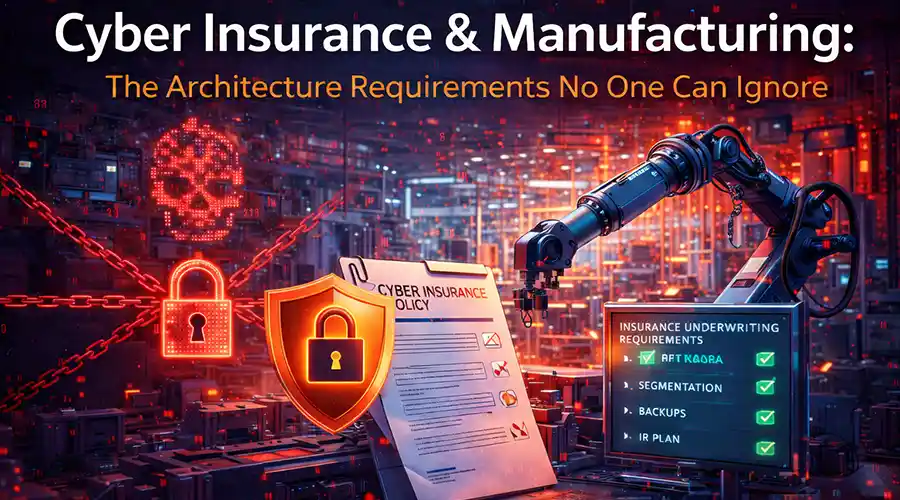
Cybersecurity for Manufacturing
Ready to see how managed IT can transform
your manufacturing enterprise?

Securing Industrial
Control Systems
Manufacturing environments face a different class of cybersecurity risk than most office-based businesses. A cyber event in a plant does not stop at user disruption. It can halt production, interrupt supply chains, block access to engineering systems, and create operational risk across the facility.
At Preactive IT Solutions, we focus on securing both business systems and the infrastructure that supports production. That includes networks, identities, endpoints, remote access, and the environments that connect engineering, operations, and corporate systems.
As manufacturing organizations adopt cloud platforms, remote access, and integrated production systems, the separation between IT and operational environments has narrowed. This improves efficiency, but it also increases exposure. A compromise in the business network can impact production if segmentation and access controls are not properly implemented.
Manufacturing Cybersecurity Requires Operational Context
Standard IT security models do not translate cleanly into manufacturing environments. Industrial systems have different constraints, including uptime requirements, vendor dependencies, and limited patching windows.
Most manufacturing environments include a mix of:
- Engineering workstations and CAD systems
- File servers and ERP platforms
- Remote access tools for vendors and support teams
- Industrial control infrastructure
- Legacy systems that cannot be easily modified
Each of these systems requires a different security approach. Some support modern controls. Others require compensating measures due to operational constraints.
Security in manufacturing is not about deploying tools universally. It is about reducing risk without disrupting production.
IT/OT Convergence Has Expanded
the Attack Surface
Manufacturers are increasingly integrating production environments with business systems, cloud platforms, and external partners. This convergence introduces efficiency, but it also changes how attacks propagate.
Common risk factors include:
- Shared credentials across environments
- Flat network architectures
- Unsecured remote access pathways
- Legacy systems connected without isolation
- Limited visibility into unmanaged devices
- Engineering systems with elevated access and internet connectivity
Attackers do not need to target industrial devices directly. They typically enter through phishing, credential compromise, or exposed systems, then move laterally until they reach critical infrastructure.
Without segmentation and access control, the path from a compromised user account to production disruption can be short.
PLC, SCADA, and HMI Systems Create Unique Attack Surfaces
Industrial control systems operate differently from conventional office systems. That difference matters from a security standpoint.
 PLCs are foundational to industrial automation. They control machine logic, sequencing, timing, and process execution. A compromise involving PLC-connected environments can affect line performance, equipment behavior, and operational continuity.
Key risks include:
- Unauthorized logic changes
- Insecure programming access
- Poor network isolation
- Shared or default credentials
- Lack of visibility into who changed what and when
 HMIs are the interface layer between people and machines. They may not be the most complex systems in the environment, but they are highly operationally sensitive. If an HMI becomes unavailable, operators may lose visibility into critical processes or lose the ability to interact with machinery efficiently.
Key risks include:
- Endpoint compromise through USB or local access
- Weak user account control
- Inadequate hardening
- Unrestricted communication with other network segments
- Lack of logging or centralized monitoring

SCADA platforms aggregate data, provide centralized monitoring, and support high-level control across industrial processes. Because SCADA systems often bridge operational visibility and business reporting, they can become a valuable target.
Key risks include:
- Exposure through remote access pathways
- Weak authentication controls
- Poorly secured historian or interface servers
- Dependence on aging operating systems or unsupported components
- Integration points that expand access into the OT environment
The Modern Manufacturer’s IT Playbook
Infrastructure, Security &
Compliance for Industry 4.0

Ransomware in Manufacturing Disrupts
Operations, Not Just Data
Ransomware is one of the most disruptive threats to manufacturing because it affects both digital systems and physical output. In many cases, production stops not because machines are encrypted, but because the systems supporting them are unavailable.
Common impact areas include:
- ERP and scheduling systems
- Engineering file access
- Production documentation and work instructions
- Remote support and vendor access
- Authentication systems and identity services
- Backup and recovery infrastructure
If users cannot authenticate, retrieve files, or communicate across systems, production can halt even when equipment remains operational.
Effective ransomware defense in manufacturing focuses on containment, recovery, and continuity, not just prevention.
Network Segmentation Between
IT and the Plant Floor
Segmentation is one of the most effective controls in manufacturing cybersecurity. It limits how far an attacker can move after gaining access.
In poorly segmented environments, business systems, internet-facing services, and production infrastructure often share network space. This allows lateral movement from user endpoints into engineering and operational systems.
Effective segmentation includes:
- Defined separation between business and OT networks
- Controlled communication paths between environments
- Restricted administrative access
- Dedicated remote access methods for vendors
- Monitoring at internal network boundaries
- Isolation of critical systems and backup environments
Segmentation does not eliminate connectivity. It enforces intentional communication and reduces the blast radius of an incident.

OT Security Must Work Within
Real Constraints
Industrial environments often include systems that cannot support modern security controls. Some devices cannot run endpoint protection. Others rely on vendor-managed configurations or legacy operating systems.
Security strategies must adapt to these realities.
Practical OT security typically includes:
- Asset identification and network mapping
- Access control for engineering and support roles
- Remote access hardening
- Segmentation and firewall policy design
- Backup validation for critical systems
- Monitoring around OT-adjacent infrastructure
- Risk-based vulnerability prioritization
The objective is to reduce exposure without introducing operational risk.
NIST, CMMC, and NIST 800-171 Requirements
Manufacturers are increasingly required to demonstrate security maturity. This is driven by customer expectations, regulatory pressure, and cyber insurance requirements.
Relevant frameworks include:
- NIST cybersecurity guidance
- NIST 800-171 for controlled information
- CMMC expectations for defense-related work
- Customer and partner security assessments
These frameworks require more than technical controls. They require documented processes, access governance, auditability, and recovery readiness.
For manufacturers, the challenge is applying these requirements within environments that include production systems and operational constraints.
Incident Response Planning for Manufacturing
Incident response in manufacturing must account for production continuity. A generic IT response plan is not sufficient.
A manufacturing-specific plan should define:
- Decision-making authority for production shutdowns
- Critical system prioritization
- Network isolation procedures
- Communication methods during outages
- Coordination between IT, engineering, and operations
- Engagement with vendors and integrators
- Backup validation and recovery sequencing
Without predefined processes, response time increases and operational impact expands.
Additional IT Resources for Manufacturing


What Preactive IT Solutions Delivers
Preactive IT Solutions works with manufacturers that need security aligned to operational environments.
Our services include:
- Manufacturing-focused security assessments
- IT and OT network segmentation design
- Remote access and identity security improvements
- Backup and disaster recovery planning
- Endpoint protection for supported systems
- Incident response planning for production environments
- Security roadmap development aligned to business risk
- Support for NIST, CMMC, and customer-driven requirements
We focus on reducing risk across the systems that support production, not just office environments.
Schedule A Free 30-Minute Consultation
No pressure, no cost, just a simple discovery meeting so we can learn about your business and offer appropriate IT solutions.
CASE STUDY
Global SOLIDWORKS PDM
Replication Deployment
"For any company with distributed SOLIDWORKS teams, the investment is well worth it."
"Preactive IT handled the implementation smoothly, even across foreign IP providers and large time-zone gaps."
Eric O’Neal
VP of Global Operations
WWT International
Meet Some of Our Certified IT Support Specialists

Marlon Hyun
IT Support Specialist
CompTIA Security+ ce Certification, Cybersecurity Compliance Framework & System Administration



What Our Client's are Saying
Our Locations

Houston TX
Preactive IT Solutions, LP
1220 Blalock Road, Suite 345
Houston, Texas 77055
Phone: (832) 583-3707
Email: [email protected]

Austin TX
Preactive IT Solutions, LP
2505 E 6th St Suite C,
Austin, TX 78702
Phone: (512) 812-7227
Email: [email protected]

San Antonio, TX
Preactive IT Solutions, LP
700 North Saint Mary's Street, Suite 1210
San Antonio, Texas 78205
Phone: (210) 864-2929
Email: [email protected]

Beaumont, TX
Preactive IT Solutions, LP
985 I-10 St suite 103,
Beaumont, TX 77706
Phone: (409) 239-0004
Email: [email protected]

Charles Swihart
Visonary & Founder
Charles has become a recognized authority in delivering IT support and solutions tailored for small to medium-sized businesses, particularly in the manufacturing, engineering, and construction sectors. His vision for Preactive IT Solutions has always been to provide enterprise-level IT services to businesses that typically lack the resources of larger corporations.
Manufacturing Cybersecurity Insights
As a technology advisor to manufacturing and industrial organizations for more than 25 years, I’ve seen cybersecurity evolve from an IT support function into a critical component of operational resilience. Today’s factories depend on tightly integrated IT and operational technology systems, meaning cyber incidents can halt production and disrupt supply chains. In this series, I examine how ransomware threats, OT/IT convergence, and cyber insurance requirements are reshaping manufacturing security architecture—and why segmentation, identity controls, and resilient recovery strategies are now essential to maintaining uptime.