
Cybersecurity for Construction Companies In Houston
Ransomware, wire fraud, and stolen credentials do not wait for a convenient time.

Cybersecurity for the Construction Industry
Ransomware, BEC & Field-Device Risk
Houston construction firms do not think of themselves as cybersecurity targets — they think of themselves as builders. Attackers see something different: deadline-driven businesses with valuable project data, complex subcontractor relationships, mobile field users, cloud collaboration platforms, and little tolerance for downtime.
Construction ranked among the most heavily targeted sectors for ransomware in 2025, with industry reporting showing a sharp year-over-year rise in data-leak victims. At the time of this page’s August 2026 review, ransomware.live listed more than 1,300 construction-industry victims in its live tracker. The threat is not theoretical. It is part of the operating environment for general contractors, subcontractors, and specialty-trade businesses that depend on digital systems to keep projects moving.
Preactive IT Solutions has specialized in IT for construction and engineering firms since 2003. Our team includes CompTIA Security+ certified professionals and Bluebeam Certified Professionals, so security is built around the tools and workflows construction companies actually use — project-management platforms, shared drawings, job-site devices, Microsoft 365 identities, remote access, and field-to-office connectivity.
Why Construction Is a Prime
Cybersecurity Target
Subcontractors, Deadlines & Cloud Exposure
Construction presents a combination of pressure points attackers understand well:
- Time-sensitive projects. A day of downtime can stop field coordination, delay milestones, and put contractual commitments at risk.
- Complex subcontractor and vendor networks. Every outside relationship creates another identity, inbox, shared folder, or project platform attackers may try to exploit.
- Mobile and temporary work environments. Field laptops, tablets, phones, job-site Wi-Fi, and temporary networks are more difficult to control than a traditional office environment.
- Heavy reliance on cloud collaboration. Procore, Bluebeam, Autodesk Construction Cloud, Microsoft 365, Teams, SharePoint, and other platforms connect internal teams with owners, subcontractors, and suppliers.
- High-value project and financial data. Bids, drawings, schedules, change orders, bank information, payroll data, and client records all have operational or extortion value.
- Low tolerance for interruption. Attackers know construction firms cannot simply stop operations for several days while systems are rebuilt.
What Attackers Are After
BIM Files, Bids & Financial Data
The data construction firms handle every day is exactly the kind of information ransomware and extortion groups can monetize:
- BIM models, Revit and AutoCAD files, and other design data
- Project bids, estimates, schedules, and RFI responses
- Change orders, submittals, and progress documentation
- Subcontractor agreements and compliance records
- Client, employee, and vendor financial information
- Proprietary estimating templates and business processes
- Microsoft 365 mailboxes, SharePoint sites, and cloud-storage accounts
- Credentials that provide access to project-management or accounting systems
A successful incident can mean more than an encrypted server. It can stop job-site coordination, expose sensitive project information, interrupt billing and payroll, trigger contractual notification requirements, and damage owner relationships that took years to build.
Construction Ransomware Groups to Know: 2025 Threat Landscape
RansomHub, Play, Akira & Qilin
Threat groups change quickly, so this table is deliberately dated rather than presented as a permanent list of currently active operators. These groups were among those associated with significant ransomware and extortion activity affecting construction organizations during the 2025 threat landscape.
| Group | 2025 Risk Profile | How They Were Known to Operate |
|---|---|---|
| RansomHub | Critical in 2025 | Major ransomware-as-a-service operation during the period; activity later ceased in its original form |
| Play | High | Fast-moving ransomware and data exfiltration with repeated attacks across construction and related sectors |
| Akira | High | Double extortion and exploitation of exposed or unpatched remote-access infrastructure |
| Qilin | High | Cross-platform ransomware affecting Windows, Linux, and virtualized environments |
| SafePay | High | Data theft paired with extortion and ransomware activity |
| Medusa | High | Longer dwell times and techniques intended to evade detection before extortion |
| DragonForce | Medium | Ransomware and public data-leak pressure against mid-market organizations |
| INC Ransom | Medium | Credential abuse, data theft, and extortion affecting organizations across multiple industries |
Threat data last reviewed: August 2026.
A common attack path is predictable: stolen credentials or a phishing message creates initial access, the attacker establishes a foothold on an endpoint or remote-access system, moves laterally into file shares or cloud accounts, steals sensitive data, and then encrypts systems or threatens public disclosure. The goal of layered security is to break that chain before it reaches the final stage.
The Construction
IT & Cybersecurity Guide
Cybersecurity, Connectivity,
Software & Compliance for Contractors

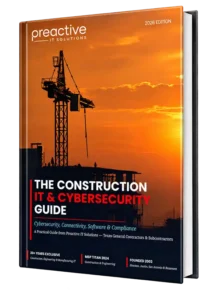
The Construction
IT & Cybersecurity Guide
Cybersecurity, Connectivity,
Software & Compliance for Contractors

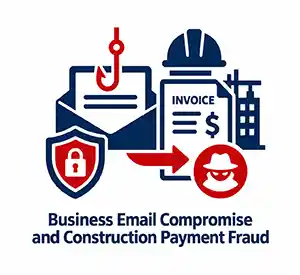
Business Email Compromise and Construction Payment Fraud
BEC, Wire Fraud & Payment Diversion
Ransomware is not the only serious construction threat. Business email compromise (BEC) and payment diversion are especially dangerous in an industry where owners, general contractors, subcontractors, suppliers, and accounting teams exchange invoices and payment instructions every day.
A compromised mailbox or convincingly spoofed domain can be used to send a fraudulent change-of-payment request that looks like it came from a real vendor. The email itself may contain no malware at all — the attacker simply relies on trust and urgency.
Construction firms can reduce that risk with a combination of technical and procedural controls:
- Multi-factor authentication and Conditional Access for Microsoft 365 accounts
- SPF, DKIM, and DMARC email-authentication controls
- Alerts for suspicious sign-ins and unusual mailbox activity
- Defined verification procedures for changes to ACH or wire instructions
- Role-based access to accounting and payment systems
- Security-awareness training using realistic subcontractor and supplier scenarios
Cybersecurity works best when the technical controls and the business process reinforce each other.
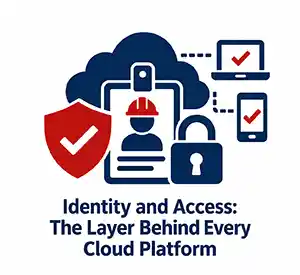
Identity and Access: The Layer Behind Every Cloud Platform
Microsoft Entra ID, MFA & Conditional Access
Modern construction security increasingly starts with identity. A superintendent may use the same Microsoft 365 identity to access email, Teams, SharePoint, cloud file storage, and connected construction platforms from a laptop, tablet, and phone. Subcontractors and temporary project participants may need access for only a portion of the project lifecycle.
Preactive IT helps construction firms manage that identity layer using technologies and practices such as Microsoft Entra ID, Microsoft Intune, multi-factor authentication, Conditional Access, single sign-on, device-compliance policies, role-based permissions, and documented onboarding and offboarding.
The objective is simple: give each employee, subcontractor, and external collaborator the access needed for the project — and remove that access when it is no longer needed. Shared passwords, forgotten guest accounts, former-employee access, and unmanaged mobile devices create unnecessary exposure around otherwise secure construction platforms.
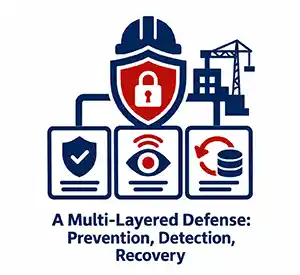
A Multi-Layered Defense: Prevention, Detection, Recovery
Prevention, Detection & Recovery Controls
No single product stops every attack. Preactive IT builds construction cybersecurity around three layers that work together.
Prevention
Prevention reduces the number of opportunities an attacker gets in the first place. That includes MFA, Conditional Access, secure Microsoft 365 configuration, endpoint protection, disciplined patch management, email security, user training, device management through Intune or another MDM platform, and least-privilege access across cloud and project systems.
Construction-specific security awareness matters. A fake subcontractor invoice, spoofed project-owner message, shared-document request, or urgent wire change is more realistic — and more useful — than generic phishing examples.
Detection
Detection catches activity prevention controls miss. Twenty-four-hour monitoring, managed endpoint detection and response, vulnerability scanning, suspicious-login alerts, behavioral anomaly detection, and network monitoring help identify compromise before attackers reach critical project data.
Network segmentation is especially important in construction. A compromised field device or temporary job-site network should not provide an unrestricted path into office servers, accounting systems, or protected project data. See our Network Infrastructure & Job-Site Connectivity page for the infrastructure side of that strategy.
Recovery
Recovery determines whether an incident becomes a short disruption or a business crisis. Backups should be protected from the same credentials and systems ransomware may compromise, and they should be tested through real restoration exercises. An incident-response plan should identify decision-makers, communication responsibilities, recovery priorities, and the systems that must come back first.
For a construction company, those priorities may include active project files, financial systems, email, schedules, and the platforms field teams need to keep working.
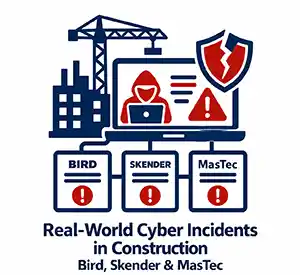
Real-World Cyber Incidents in Construction
Bird, Skender & MasTec Incidents
Named incidents make the risk easier to understand:
Bird Construction, a Toronto general contractor with Canadian federal work, was hit by Maze ransomware in 2019. Attackers stole roughly 60 GB of data and demanded a multi-million-dollar ransom, exposing sensitive employee and project information.
Skender Construction, a Chicago general contractor, disclosed a 2024 double-extortion incident involving more than 600 GB of stolen data, including architectural drawings, financial records, and personal information. The company did not pay the ransom.
MasTec, a publicly traded infrastructure engineering and construction company, was affected by a third-party compromise associated with Clop activity, exposing personal and financial information for thousands of individuals.
These cases involve different firms, different attack paths, and different operating environments. The common lesson is that preparation before an incident has a direct effect on what happens after one.

Case Study
General Contractor Network & Security Overhaul
A Texas general contractor with more than 100 employees, previously reliant on a small, reactive IT provider, now runs on a fully managed, monitored environment. Preactive IT implemented company-wide endpoint security, email filtering, backup and disaster recovery, formal help-desk support, and a redesigned high-availability network.
The engagement shows how cybersecurity improves when it is built into the infrastructure and support model instead of added as a standalone tool.
“When our network hit a critical crisis, their team jumped in without missing a beat, troubleshot the issue, and had us fully back up and running by the end of the day. Partnering with them for our ongoing IT and network needs has given us a completely different level of confidence.”
Director of Human Resources, Texas General Contractor
Schedule A Free 30-Minute Consultation
No pressure, no cost, just a simple discovery meeting so we can learn about your business and offer appropriate IT solutions.
Additional IT Resources for Houston & South Texas Construction Companies
Related Construction IT & Security Pages
- Download The Construction IT & Cybersecurity Guide
- IT Services for Construction Companies
- Procore, Bluebeam & Construction Software Support
- Network Infrastructure & Job-Site Connectivity
- AutoCAD, Revit & BIM Support for Construction
- IT & Cybersecurity Compliance for Construction Companies
- Construction General Contractor IT Case Study

Meet Some of Our Certified IT Support Specialists

Marlon Hyun
IT Support Specialist
CompTIA Security+ ce Certification, Cybersecurity Compliance Framework & System Administration



Frequently Asked Questions: Cybersecurity for Constructions
What are the most common cybersecurity risks faced by construction companies?
The biggest risks include ransomware, business email compromise and payment fraud, phishing, stolen credentials, unmanaged field devices, insecure remote access, weak subcontractor access controls, and exposed project data. BIM and CAD files, bids, estimates, financial records, RFIs, change orders, and Microsoft 365 accounts are especially important to protect.
Why is the construction industry targeted by cyber attacks?
Construction combines time-sensitive projects, complex vendor and subcontractor relationships, mobile field environments, valuable project and financial data, and low tolerance for downtime. Those characteristics create both technical attack paths and business pressure attackers can exploit.
How can construction companies effectively mitigate cyber risks?
Use layered controls: identity protection and MFA, endpoint security, email protection, patch management, employee training, network segmentation, 24/7 monitoring, protected backups, and a tested incident-response plan. The controls should cover office systems, job-site devices, cloud platforms, and external collaborators rather than only the corporate network.
What role does Microsoft 365 security play in construction cybersecurity?
Microsoft 365 often sits at the center of email, Teams, SharePoint, OneDrive, identity, and external collaboration. Entra ID, Intune, MFA, Conditional Access, device compliance, and disciplined guest-account management help protect the identity layer that many other construction applications depend on.
How can construction companies reduce business email compromise and wire fraud?
Protect mailboxes with MFA and Conditional Access, configure SPF/DKIM/DMARC, monitor suspicious sign-ins, train employees on vendor-impersonation scenarios, and require an independent verification step before changing ACH or wire instructions.
How can small and mid-sized construction firms start improving cybersecurity?
Start with a practical assessment, enable MFA, protect Microsoft 365 identities, confirm backups can actually be restored, secure every endpoint, and train staff on construction-specific phishing and payment-fraud scenarios. Those steps address several of the most common entry points without requiring an enterprise security program on day one.
How does increased digitization affect cybersecurity in construction projects?
Cloud project-management systems, mobile field devices, IoT sensors, drones, telematics, remote BIM collaboration, and shared owner/subcontractor platforms all expand the attack surface. The goal is not to avoid those technologies; it is to pair them with identity controls, managed devices, network segmentation, monitoring, and clear access policies.
Are construction companies required to comply with specific cybersecurity regulations?
There is no single cybersecurity law that applies to every construction company. Requirements depend on contracts, project type, the information a firm handles, insurance conditions, and whether it works on federal or defense-related projects. DFARS, CMMC, NIST 800-171, cyber-insurance controls, breach-notification rules, and owner or GC security requirements may all become relevant. See IT & Cybersecurity Compliance for Construction Companies for more detail.
Our Locations

Houston TX
Preactive IT Solutions, LP
1220 Blalock Road, Suite 345
Houston, Texas 77055
Phone: (832) 944-6250
Email: [email protected]

Austin TX
Preactive IT Solutions, LP
2505 E 6th St Suite C,
Austin, TX 78702
Phone: (512) 812-7227
Email: [email protected]

San Antonio, TX
Preactive IT Solutions, LP
700 North Saint Mary’s Street, Suite 1210
San Antonio, Texas 78205
Phone: (210) 864-2929
Email: [email protected]

Beaumont, TX
Preactive IT Solutions, LP
985 I-10 St suite 103,
Beaumont, TX 77706
Phone: (409) 239-0004
Email: [email protected]