
IT & Cybersecurity Compliance for Construction Companies
Cyber insurance, federal contracts, and security questionnaires all ask the same question: can you prove the controls exist?

IT & Cybersecurity Compliance, Scoped Correctly
Systems, Controls & Audit-Ready Evidence
Construction compliance spans many disciplines, and not all of them belong to an IT provider. OSHA safety rules, building-code interpretation, employment requirements, certified payroll, bonding, and contract law each require the appropriate construction, legal, accounting, or regulatory expertise.
Preactive IT Solutions focuses on the part that does belong to IT: the systems, cybersecurity controls, access records, backups, documentation, and evidence construction firms increasingly need to satisfy cyber insurance requirements, customer and owner security questionnaires, contractual flow-downs, and federal cybersecurity standards such as DFARS and CMMC.
The goal isn’t to turn an MSP into a compliance consultant. It’s to make the technology environment easier to document, verify, protect, and audit.
Where IT Compliance Shows Up in Construction
Cyber Insurance, Contracts, Federal Standards & More
A construction company’s IT obligations often arrive indirectly. They may appear in:
- A cyber-insurance renewal questionnaire
- An owner or general contractor’s security requirements
- A subcontractor agreement or contractual flow-down
- A federal project involving Controlled Unclassified Information (CUI)
- A DFARS clause or CMMC requirement
- A request to document MFA, endpoint security, backups, or incident response
- A requirement to retain and retrieve project, payroll, safety, or financial records
- A vendor-security or third-party risk questionnaire
The technology controls may be the same controls Preactive would recommend for sound IT operations anyway. Compliance changes the additional requirement: the firm may need to prove those controls exist and are operating as intended.
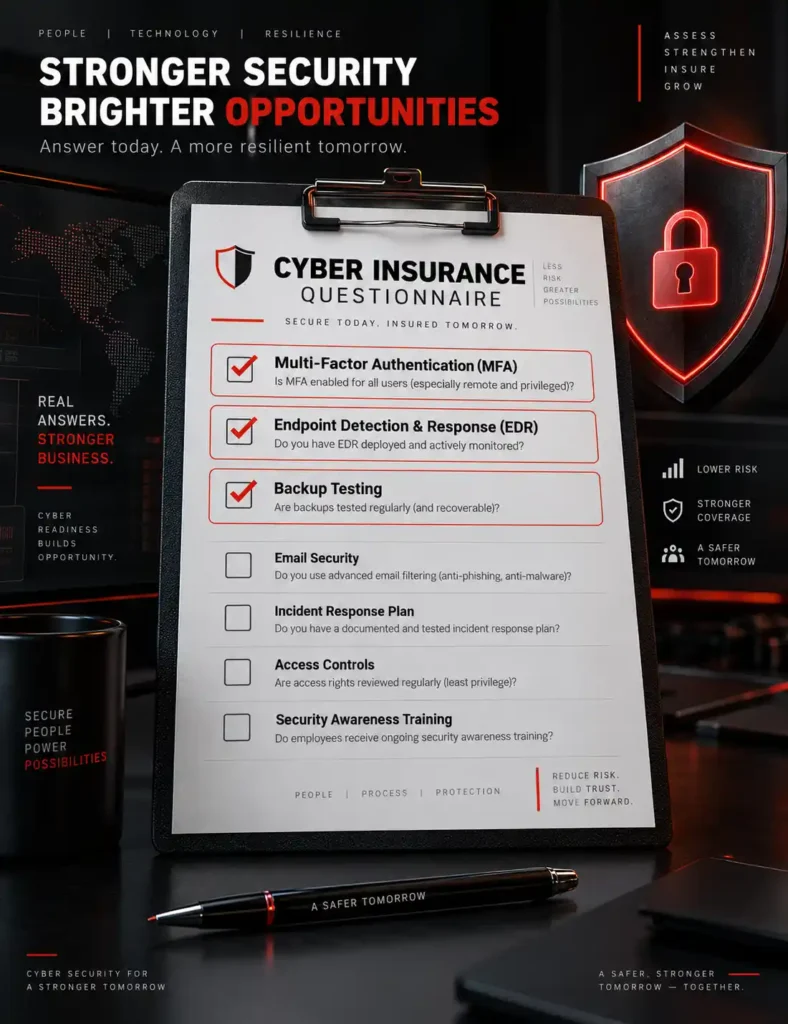
The Construction
IT & Cybersecurity Guide
Cybersecurity, Connectivity,
Software & Compliance for Contractors

The Construction
IT & Cybersecurity Guide
Cybersecurity, Connectivity,
Software & Compliance for Contractors
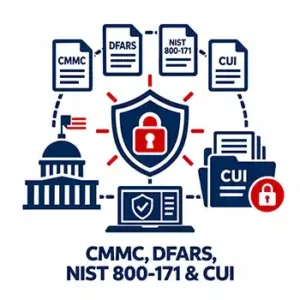
CMMC, DFARS, NIST 800-171 & Controlled Unclassified Information
Federal Cybersecurity Requirements for Defense-Adjacent Work
Construction and engineering firms that participate in Department of Defense or defense-adjacent work may encounter DFARS cybersecurity clauses, CMMC requirements, and NIST SP 800-171 controls when they store, process, or transmit Controlled Unclassified Information.
Those requirements can affect:
- Identity and access control
- Multi-factor authentication
- Device and endpoint security
- Logging and monitoring
- Network segmentation
- Incident response
- Vulnerability and configuration management
- Media and data protection
- Backup and recovery
- Documentation of policies, procedures, and evidence
CMMC and DFARS obligations depend on the contract, information involved, and required assessment level. Preactive IT can help implement and manage technical controls, but contractors should confirm legal and contractual applicability with qualified compliance advisors.
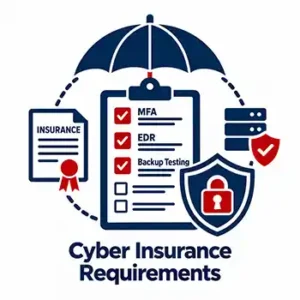
Cyber Insurance Requirements
MFA, EDR, Backups & Underwriter Questionnaires
Cyber insurance has moved from a simple risk-transfer decision to a technical due-diligence exercise. Underwriters commonly ask detailed questions about controls such as:
- MFA for email, remote access, and privileged accounts
- Endpoint protection or EDR
- Backup isolation and restoration testing
- Security-awareness training
- Patch and vulnerability management
- Email security
- Incident-response planning
- Privileged-access controls
- Remote-access security
The most important time to discover a gap is before the application is signed or a claim occurs. Preactive IT helps construction firms compare the controls they have in place with the controls they’re being asked to represent, then close technical gaps where appropriate.
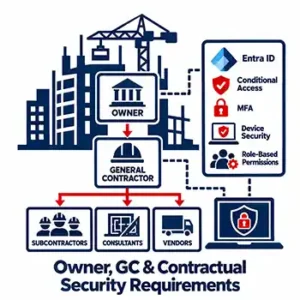
Owner, GC & Contractual Security Requirements
Entra ID, Conditional Access & Access Flow-Downs
Cybersecurity expectations increasingly flow down through project relationships. An owner may impose security requirements on the general contractor, which then passes requirements to subcontractors, consultants, and vendors.
Those requirements may cover access to project platforms, protection of confidential information, notification after an incident, use of MFA, device security, subcontractor access, or data retention.
A documented identity and access process makes these requirements easier to manage. Microsoft Entra ID, Intune, Conditional Access, role-based permissions, named user accounts, and consistent onboarding/offboarding can provide stronger control over employees, subcontractors, and outside collaborators.
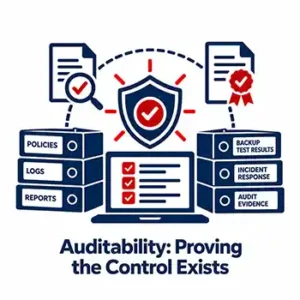
Auditability: Proving the Control Exists
Evidence, Logs & Documentation That Hold Up
A security control is more useful when the organization can demonstrate it. Construction firms may need evidence such as:
- User and administrator account inventories
- MFA and Conditional Access policies
- Endpoint protection status
- Patch and vulnerability reports
- Backup success and restoration-test records
- Security-monitoring and alert records
- Incident-response plans and tabletop exercises
- Help-desk tickets documenting remediation
- Access reviews for subcontractors or former employees
Preactive IT’s process — Audit, Prioritize, Plan, Execute, Review — naturally creates opportunities to document controls instead of treating compliance evidence as an emergency project before an audit or renewal.

Case Study
General Contractor Network & Security Overhaul
A Texas general contractor with more than 100 employees, previously reliant on a small, reactive IT provider, now runs on a fully managed, monitored environment. Preactive IT implemented company-wide endpoint security, email filtering, backup and disaster recovery, formal help-desk support, and a redesigned high-availability network.
The engagement shows how cybersecurity improves when it is built into the infrastructure and support model instead of added as a standalone tool.
“When our network hit a critical crisis, their team jumped in without missing a beat, troubleshot the issue, and had us fully back up and running by the end of the day. Partnering with them for our ongoing IT and network needs has given us a completely different level of confidence.”
Director of Human Resources, Texas General Contractor
Schedule A Free 30-Minute Consultation
No pressure, no cost, just a simple discovery meeting so we can learn about your business and offer appropriate IT solutions.
Additional IT Resources for Construction Companies
Related Construction IT & Compliance Pages

Meet Some of Our Certified IT Support Specialists

Marlon Hyun
IT Support Specialist
CompTIA Security+ ce Certification, Cybersecurity Compliance Framework & System Administration


Frequently Asked Questions: Compliance for Construction Companies
What cybersecurity compliance standards can apply to construction companies?
The answer depends on contracts, project type, customers, and the information handled. Construction firms may encounter CMMC, DFARS, NIST 800-171, cyber-insurance control requirements, owner or GC security questionnaires, breach-notification obligations, and contractual security flow-downs.
What is CUI and why does it matter to contractors?
Controlled Unclassified Information is government information that requires safeguarding even though it isn’t classified. Construction and engineering firms working on certain federal or defense projects may need to protect CUI according to contract requirements and standards such as NIST 800-171 and CMMC.
Does every construction company need CMMC?
No. CMMC applicability depends on Department of Defense contracts and the information a contractor or subcontractor handles. Firms should review contract requirements with qualified compliance or legal advisors rather than assuming CMMC applies to every construction project.
What does cyber insurance usually ask construction firms to document?
Questionnaires commonly ask about MFA, endpoint protection, backups, restoration testing, patch management, email security, privileged accounts, remote access, employee training, and incident response. The exact requirements vary by carrier and policy.
How does IT support help with construction compliance and audits?
IT support can implement the technical controls, keep systems available, generate operational records, document changes, support access reviews, test backups, and provide evidence that security processes are operating. That reduces the amount of last-minute evidence gathering required before a questionnaire, renewal, or assessment.
Does Preactive IT provide OSHA or building-code compliance consulting?
No. Preactive IT supports the technology used to store, secure, back up, and retrieve construction records. OSHA, building-code, legal, accounting, and other regulatory interpretation should remain with the appropriate qualified professionals.
Our Locations

Houston TX
Preactive IT Solutions, LP
1220 Blalock Road, Suite 345
Houston, Texas 77055
Phone: (832) 944-6250
Email: [email protected]

Austin TX
Preactive IT Solutions, LP
2505 E 6th St Suite C,
Austin, TX 78702
Phone: (512) 812-7227
Email: [email protected]

San Antonio, TX
Preactive IT Solutions, LP
700 North Saint Mary’s Street, Suite 1210
San Antonio, Texas 78205
Phone: (210) 864-2929
Email: [email protected]

Beaumont, TX
Preactive IT Solutions, LP
985 I-10 St suite 103,
Beaumont, TX 77706
Phone: (409) 239-0004
Email: [email protected]