
Do Houston construction and engineering firms need CMMC, NIST 800-171 or TX-RAMP?
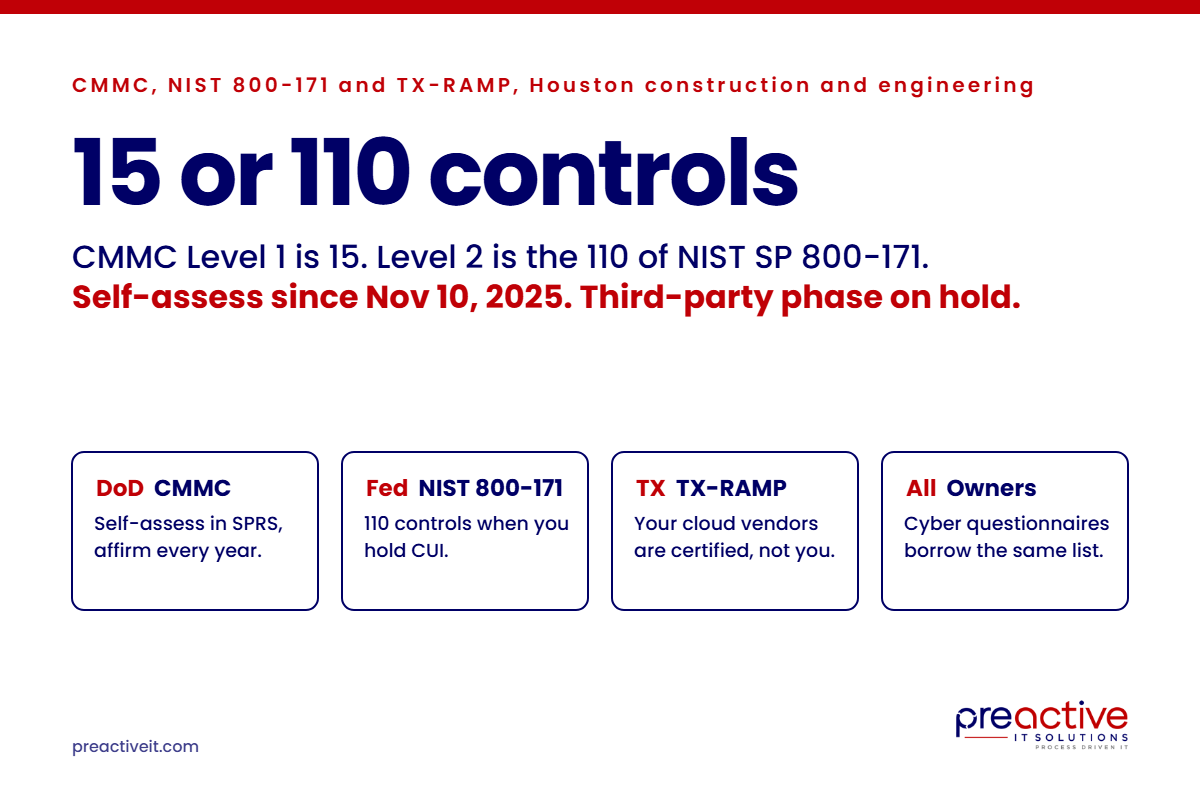
It depends on who your contracts are with. If any of your work touches a Department of Defense contract, even as a subcontractor, CMMC applies and the clock already started: since November 10, 2025, new DoD awards can require a CMMC Level 1 or Level 2 self-assessment as a condition of award. The third-party assessment phase that was due to start November 10, 2026 is suspended while the Pentagon reviews the program, but self-assessments and annual affirmations are still required. NIST SP 800-171 is the 110-control standard that CMMC Level 2 is built on. TX-RAMP is different: it applies to cloud services sold to Texas state agencies, not to the engineering firm doing TxDOT or university work, though it does limit which cloud tools that work can run on.
Below I cover which rule goes with which contract, what each one requires and what it costs a 40 to 250 user firm. Preactive IT Solutions supports NIST, CMMC and DFARS work for Houston construction and engineering firms. Compliance projects are quoted separately.
Which compliance rule applies to which contract?
| If your contract is with | The rule | What it means for your IT |
|---|---|---|
| Department of Defense, directly or as a sub, and you handle Federal Contract Information | CMMC Level 1 | 15 basic safeguards, annual self-assessment posted in SPRS, affirmed every year |
| Department of Defense and you handle Controlled Unclassified Information (drawings, specs, site data marked CUI) | CMMC Level 2, built on NIST SP 800-171 | 110 controls, assessed every three years by self-assessment or a certified third party, affirmed annually |
| Any federal agency and you handle CUI | NIST SP 800-171 when the agency’s contract clause requires it | Same 110 controls, no CMMC certification layer |
| Texas state agency, university or community college | TX-RAMP, applied to your cloud vendors | Confidential state data must sit in TX-RAMP certified cloud services; your firm is not certified, your tools are |
| Private owners, GCs, developers | Whatever the contract or insurer asks for | Increasingly a cyber questionnaire that borrows from NIST 800-171 |
Read the clauses. For DoD work, look for DFARS 252.204-7012 and 252.204-7021 in the contract or the flow-down from your prime. Older contracts may also carry 252.204-7019 and 7020; since February 2026, 7019 is gone and 7020 was renumbered 252.240-7997. For state work, look for data security language that points to TX-RAMP or the Texas Government Code cloud security requirement. If none of that is in your contracts, you do not need a certification. You still need the controls, because the private-owner questionnaires and cyber insurance applications ask for the same things.
What does CMMC actually require, and when?
CMMC has three levels. Most construction and engineering subs only deal with the first two.
- Level 1 covers Federal Contract Information, which is anything not meant for public release that you got under a government contract. It is 15 requirements from FAR 52.204-21: who can log in, passwords and sign-in checks, patching, antivirus and wiping old drives. You self-assess, post the result in the DoD’s SPRS system and have a company officer affirm it every year.
- Level 2 covers Controlled Unclassified Information: drawings, specifications, site plans and technical data the government has marked. It is the 110 requirements of NIST SP 800-171. Right now it is met by a self-assessment every three years. An assessment by a certified third-party assessor, a C3PAO, was due to become the default on November 10, 2026 and is suspended until further notice. Either way an officer affirms compliance annually, and a false affirmation can bring False Claims Act exposure. That lands on the officer who signs it, and the government can recover up to three times its loss.
- Level 3 adds 24 more requirements and a government-led assessment. It is for the most sensitive programs. Most contractors in our size range never see it.
The rollout is phased from the rule’s publication date, September 10, 2025:
- Phase 1, November 10, 2025: Level 1 and Level 2 self-assessments can be required as a condition of award.
- Phase 2, November 10, 2026: Level 2 third-party assessments were to become the default. Suspended by the DoD CIO on July 13, 2026 while a CMMC Reform Task Force reviews the program. Contracting officers can only require self-assessments and no restart date has been published.
- Phases 3 and 4, November 2027 and November 2028: Level 3 and CMMC on every applicable contract, including option periods. Both on hold until the review ends.
Primes have to pass the requirement down to every sub that handles FCI or CUI. If you are a mechanical or electrical sub on a base project, expect the prime to ask for your SPRS score before your next award. No score on file can cost you the invite. The pause did not change that, and primes can still ask for more than the government does.
What does NIST SP 800-171 require from a 50-user engineering firm?
The 110 controls sort into 14 families, and most of the work for a firm this size falls into six of them.
- Access control and identification: multifactor authentication for every user, named accounts only, least privilege, remote access through a secured gateway.
- Configuration management: a standard build for every workstation and server, documented, with no local admin rights for users.
- System and information integrity: patching on a schedule, endpoint protection on every device, monitoring that someone actually reads.
- Audit and accountability: logs kept long enough to answer “who opened that file” after the fact.
- Media protection and physical security: encrypted laptops and drives, controlled access to the server room and the plan room.
- Incident response and awareness training: a written plan, a tested backup and staff who know what a phishing email looks like.
The first question is scope. If CUI only touches ten engineers on one project, you can build an enclave for those ten users and assess that, instead of bringing all 50 users to the standard. That is the biggest cost decision in a CMMC project. You make it before you buy anything.
What does TX-RAMP mean for firms that do Texas state work?
TX-RAMP is the Texas state program, started by the Department of Information Resources and now run by the Texas Cyber Command, that certifies cloud services before a state agency, public university or community college may put confidential state data in them. It has two levels, based on the NIST 800-53 low and moderate baselines, plus a provisional status that lasts 18 months while a vendor completes certification. Version 3.0 took effect at the end of December 2023.
The certified party is the cloud vendor, not your firm. For a Houston engineering firm doing work for TxDOT, a university system or a port authority, TX-RAMP shows up in two ways. First, if the agency sends you confidential data, your contract may require that it live only in TX-RAMP certified services, so your document management, file sharing and project collaboration tools have to be on the list. Second, if your firm sells any hosted service to a state entity, that service needs its own certification. For most AEC firms only the first applies, and it is a vendor-selection question your IT provider should answer before you sign the contract, not after.
What does it cost to get compliant?
For a 40 to 250 user firm already on managed IT services with the basics in place, the controls themselves are mostly configuration, policy and documentation rather than new hardware. The costs that surprise people are the assessment, the enclave and the hours your own staff spend gathering evidence.
- Level 1 self-assessment: staff time and your IT provider’s time to document 15 controls. Days, not months, if the environment is standardized.
- Level 2 self-assessment: a gap assessment, remediation of what is missing, a System Security Plan and a Plan of Action. For a standardized environment, a few months of work. For one that has grown without standards, longer and more expensive.
- Level 2 third-party assessment: the C3PAO’s fee on top of the above, set by the assessor and the size of the scope. Scoping to an enclave is what keeps this reasonable.
- Tools: a secured file-sharing and email environment for CUI is the common added subscription, licensed per user.
Preactive’s managed IT services fee of $160 to $180 per user per month already covers most of the technical controls: the security tools, patching, backup, monitoring and account management. Compliance documentation, gap assessments and enclave design are quoted as projects. You see the price before we start.
Where should a firm start?
- Pull every active contract and list the clauses: DFARS 7012 and 7021, the older 7019 and 7020 or their replacement 252.240-7997, FAR 52.204-21 or its new number 52.240-93, TX-RAMP language, owner cyber requirements.
- Decide what data is actually CUI and who touches it. That sets the scope.
- Run a gap assessment against NIST SP 800-171 for that scope.
- Fix the gaps, write the System Security Plan, post the score in SPRS.
- Put the annual affirmation and the three-year reassessment on the calendar, with a named officer.
I am not a lawyer, and this is not legal advice. Your contracts and your prime’s flow-downs decide what applies to you, so have a government contracts attorney read the clauses. What I can tell you is what the controls require on the IT side.
Frequently asked questions
Does a construction subcontractor need CMMC?
Yes, if the subcontract involves a Department of Defense project and the firm handles Federal Contract Information or Controlled Unclassified Information. Primes must flow CMMC down to subcontractors. Since November 10, 2025, a Level 1 or Level 2 self-assessment can be required as a condition of award. The third-party assessment phase planned for November 10, 2026 is suspended until further notice, so self-assessment is the current path.
What is the difference between CMMC and NIST 800-171?
NIST SP 800-171 is the set of 110 security controls for protecting Controlled Unclassified Information. CMMC is the Department of Defense’s program for verifying that contractors meet them. CMMC Level 2 is NIST 800-171 plus an assessment, either self-assessed or by a certified third party, with an annual affirmation by a company officer.
Do engineering firms doing TxDOT work need TX-RAMP certification?
Usually not. TX-RAMP certifies cloud services sold to Texas state agencies, universities and community colleges, not the engineering firm using them. The firm’s obligation is to keep confidential state data in TX-RAMP certified services when the contract requires it, which makes it a question of which file sharing and collaboration tools the firm uses.
How many controls are in CMMC Level 1 and Level 2?
Level 1 has 15 requirements, drawn from FAR 52.204-21, for protecting Federal Contract Information. Level 2 has 110 requirements, the full NIST SP 800-171 Revision 2, for protecting Controlled Unclassified Information. Level 3 adds 24 requirements from NIST SP 800-172 and a government-led assessment.
What is a CMMC enclave?
A separately managed set of users, devices and systems that handles Controlled Unclassified Information, so only that part of the firm has to meet NIST 800-171. A 50-user engineering firm with ten engineers on a Department of Defense project can scope the enclave to those ten, which cuts the assessment cost and the number of controls that have to be proven.
How long does it take to get CMMC Level 2 ready?
For a firm already on managed IT services with standardized systems, a few months from gap assessment to a posted SPRS score for a scoped enclave. For a firm with unstandardized systems, longer. The third-party assessment, when required, is scheduled with a certified assessor after the firm’s own gaps are closed.
About Preactive IT Solutions
Preactive IT Solutions is a Houston managed IT services provider specializing in construction and engineering firms, serving Texas businesses since 2003. We support organizations of 40 to 250 users with a 24/7 help desk staffed by our own technicians, one technician per 150 users, compliance support for NIST, CMMC and DFARS and an average client relationship of more than eight years. See the full managed IT services in Houston offering, or ask us to walk through the IT requirements in your contracts.
Sources
- Schwabe, DoD issues final rule implementing CMMC requirements in DFARS: phase dates, level requirements, SPRS affirmation and flow-down.
- Federal News Network, Pentagon suspends CMMC phase two requirements: the July 13, 2026 suspension and review.
- Texas DIR, TX-RAMP frequently asked questions: levels, provisional status and the Texas Cyber Command transfer.
- Secureframe, Understanding TX-RAMP 3.0: scope, levels, provisional status and the 3.0 changes.