
The short answer
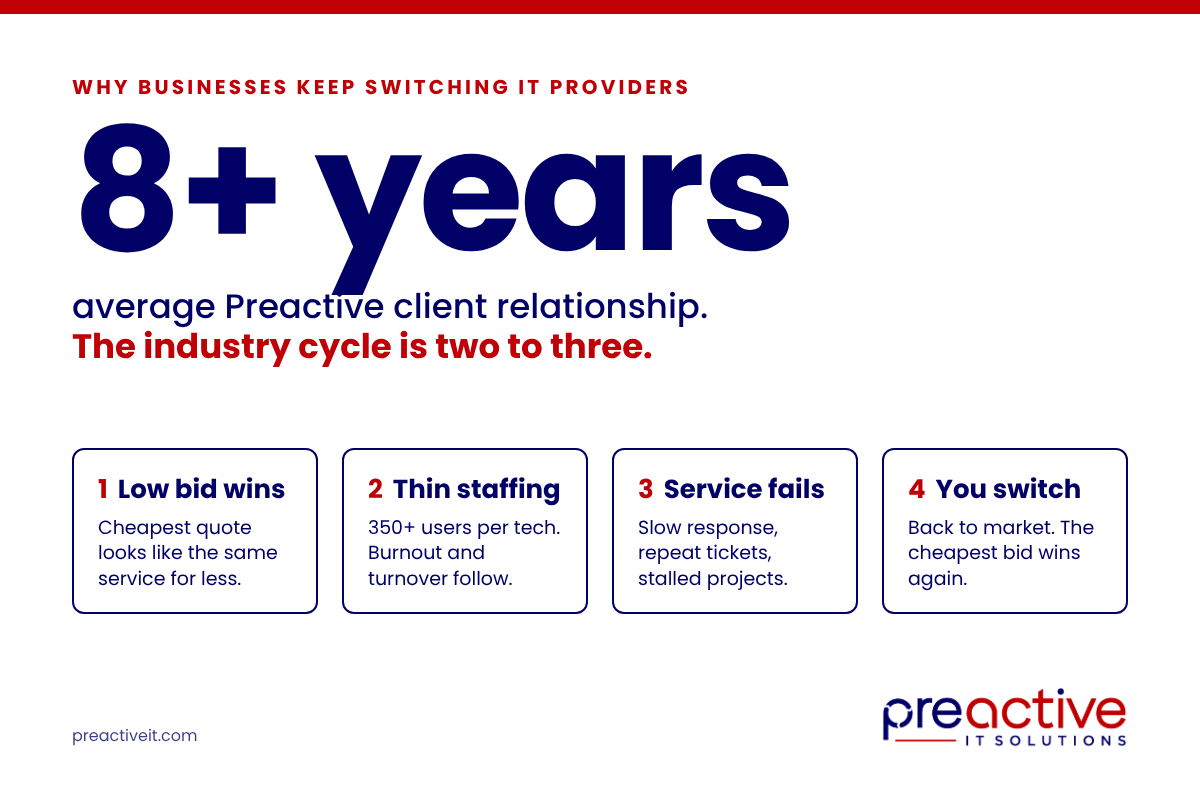
Businesses switch IT providers every two or three years because they keep choosing on price, and low prices force a staffing model that cannot deliver good service. The provider underprices to win the deal, spreads too few technicians across too many users, the technicians burn out and leave, service collapses, and the client leaves for the next low bid. The cycle repeats until someone chooses on different numbers. Preactive IT Solutions’ average client has been with us for more than eight years, and this post explains the difference.
The cycle, step by step
- The low bid wins. Three proposals come in. The cheapest is 20 or 30 percent under the others. It looks like the same service for less money, so it wins.
- The price forces thin staffing. Labor is an MSP’s largest cost. The only way to deliver that price is to assign each technician 300 or more users, use remote or offshore staff, or both. We cover the math in what a good tech-to-user ratio looks like.
- Technicians burn out. Overloaded technicians work the urgent tickets and drop the quiet work: patching, alert review, documentation. Then they quit. Each departure takes knowledge of your environment with it.
- Service falls apart. You see it as slow response, repeat tickets, stalled projects and an account manager who only calls at renewal. Underneath, the hidden problems are worse.
- You switch. Frustrated, you go back to market. Three proposals come in. The cheapest is 20 or 30 percent under the others.
What switching actually costs
Each change of provider costs far more than the monthly savings that caused it.
- Onboarding disruption. New agents on every machine, new passwords, new procedures, and weeks of “who do I call now?”
- Lost knowledge. Everything the old provider knew about your network, your quirks and your people is gone. The new provider learns it by making the same mistakes again.
- Security gaps during the handoff. Monitoring lapses, old accounts linger, and nobody owns the alerts for a while.
- Management time. Someone in your company runs the transition instead of running the business.
For a Houston construction or engineering firm, a bad transition can land in the middle of a bid or a project closeout. The cost is measured in missed deadlines, not help desk tickets.
How to break the cycle
Choose on the numbers that predict service, and let price come last.
| Choose on this | Instead of this |
|---|---|
| Tech-to-user ratio (about 1 to 150) | Lowest monthly price |
| Average client tenure (several years) | Number of logos on the website |
| Published help desk metrics | Promised SLAs in the contract |
| Local, employed technicians you have met | “Global support team” |
| A price built from real costs | A price built to beat the other bids |
We walk through the four questions that surface these numbers in how to compare managed IT providers in Houston, and the pricing side in MSP pricing in Houston.
What eight-plus years looks like
Our average client relationship is more than eight years. That number is not a marketing claim. It is what happens when a provider staffs one technician per 150 users, keeps every technician in its own office, publishes its help desk numbers each quarter, and prices from the real cost of good service. Clients stay because the service holds up year after year, and because the technician who fixed their problem in 2019 is often the one who fixes it in 2026.
Frequently asked questions
How often do businesses change IT providers?
Many companies change every two or three years, usually after a low-priced provider fails to deliver. Choosing on staffing and tenure instead of price breaks the pattern.
Why does my IT provider keep getting worse?
Usually because the price you pay does not fund enough technicians, so the team is overloaded and turning over. The service was never sustainable at that price.
What is the cost of switching IT providers?
Onboarding disruption, lost knowledge of your environment, security gaps during the handoff and management time. These usually exceed the monthly savings that prompted the switch.
How long do Preactive IT Solutions clients stay?
More than eight years on average.
About Preactive IT Solutions
Preactive IT Solutions is a Houston managed IT services provider specializing in construction and engineering firms, serving Texas businesses since 2003. We support organizations of 40 to 250 users with a 24/7 help desk and one technician per 150 users. If you are on your second or third provider, talk to us before you pick a fourth.