
The short answer
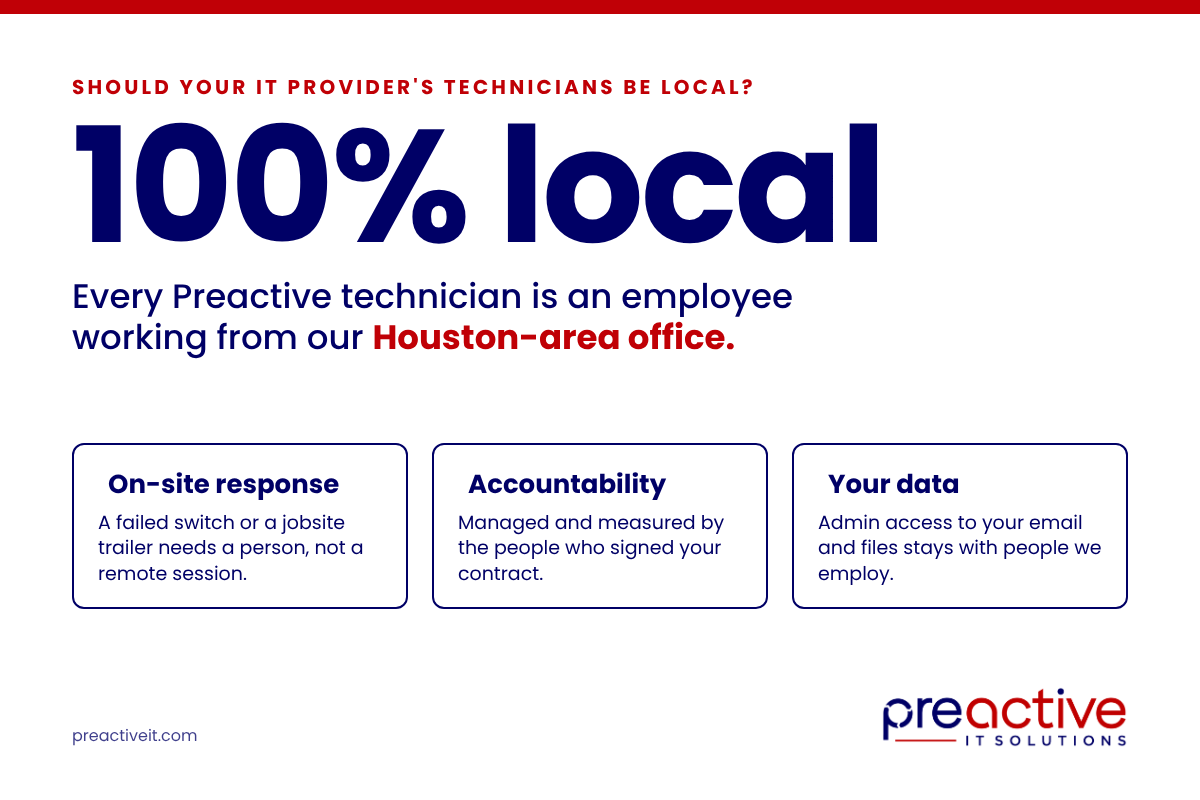
For most Houston businesses, and especially for construction and engineering firms, the answer is yes: your IT provider’s technicians should be local employees working from the provider’s own office. Remote and offshore help desks are the main way low-priced MSPs cut costs. The trade-off shows up as slower escalation, no on-site response, less accountability and your company’s data handled by people the provider does not directly employ. Every Preactive IT Solutions technician works from our Houston-area office, and this post explains why we have never outsourced that.
Why some providers go remote
Technician labor is the largest cost in managed IT. A provider that moves its help desk to contractors in another state or another country can cut that cost dramatically and pass part of the savings into a lower quote. That is not inherently wrong, but it is rarely disclosed in the proposal, and the client pays for it later in ways that do not appear on the invoice. The pricing side of this is covered in MSP pricing in Houston.
What you give up with a remote help desk
On-site response
Some problems cannot be fixed over a remote session: a failed switch, a server that will not boot, a jobsite trailer with no connectivity, a plan room workstation that needs a hardware swap. A remote help desk has to dispatch a third party, if it has one, and you wait. A local team sends a technician who already knows your building.
Escalation speed
When a front-line technician is stuck, the fix is to hand the ticket to someone more senior. In an office, that is a conversation across the room. Across time zones and contractor boundaries, it is a ticket in another queue.
Accountability
Employees in one office are managed, trained and measured by the people who signed your contract. Contractors are managed by someone else, with different incentives, and they turn over faster. The name on your ticket this month may not exist next month.
Knowledge of your environment
Good support depends on remembering that your estimating server is finicky after patches or that the field superintendent’s tablet needs a specific VPN profile. Stable, local technicians accumulate that knowledge. Rotating remote staff start from the ticket notes every time.
Data handling
Your technicians have administrative access to your email, files and financial systems. Where those people sit, who employs them, and what agreements govern them are legitimate questions, especially for firms handling client plans, bid documents or anything covered by contract requirements.
When remote support is fine
Remote work is not the problem. Most tickets are resolved remotely, and that is efficient. The question is who is doing the remote work. A technician in the provider’s own office, who can walk to your site when needed, is different from a contractor on another continent who cannot. Ask which one you are getting.
How to tell which kind of provider you are talking to
- Visit the office. Count the desks and the people at them. Compare that to the number of technicians in the proposal.
- Ask where the help desk answers from. Listen for “our global team,” “our partner,” or an answer that changes depending on the time of day.
- Ask who employs the technicians. W-2 employees of the provider, or contractors of someone else?
- Ask for on-site response time. A provider with no local staff will hedge.
These are two of the four questions in how to compare managed IT providers in Houston.
How Preactive does it
All Preactive technicians are Preactive employees, and all of them work from our office in the Houston area. We staff one technician per 150 users, our average client has been with us for more than eight years, and we publish our help desk metrics every quarter. You are welcome to come meet the people who will answer your calls before you sign anything.
Frequently asked questions
Does it matter if my IT provider uses offshore technicians?
Yes. Offshore or contract help desks lower the provider’s cost but typically slow escalation, remove on-site response, reduce accountability and put your data in the hands of people the provider does not employ.
How do I know if my MSP outsources its help desk?
Visit the office and count the technicians, ask where the help desk answers from, and ask whether the technicians are the provider’s own employees.
Is remote IT support bad?
No. Most tickets are best resolved remotely. The issue is whether the remote technician is a local employee who can also come on site, or an offshore contractor who cannot.
Are Preactive IT Solutions’ technicians local?
Yes. Every Preactive technician is an employee working from the company’s Houston-area office. Nothing is outsourced.
About Preactive IT Solutions
Preactive IT Solutions is a Houston managed IT services provider specializing in construction and engineering firms, serving Texas businesses since 2003. We support organizations of 40 to 250 users with a 24/7 help desk staffed entirely by our own local technicians. Come meet the team.