
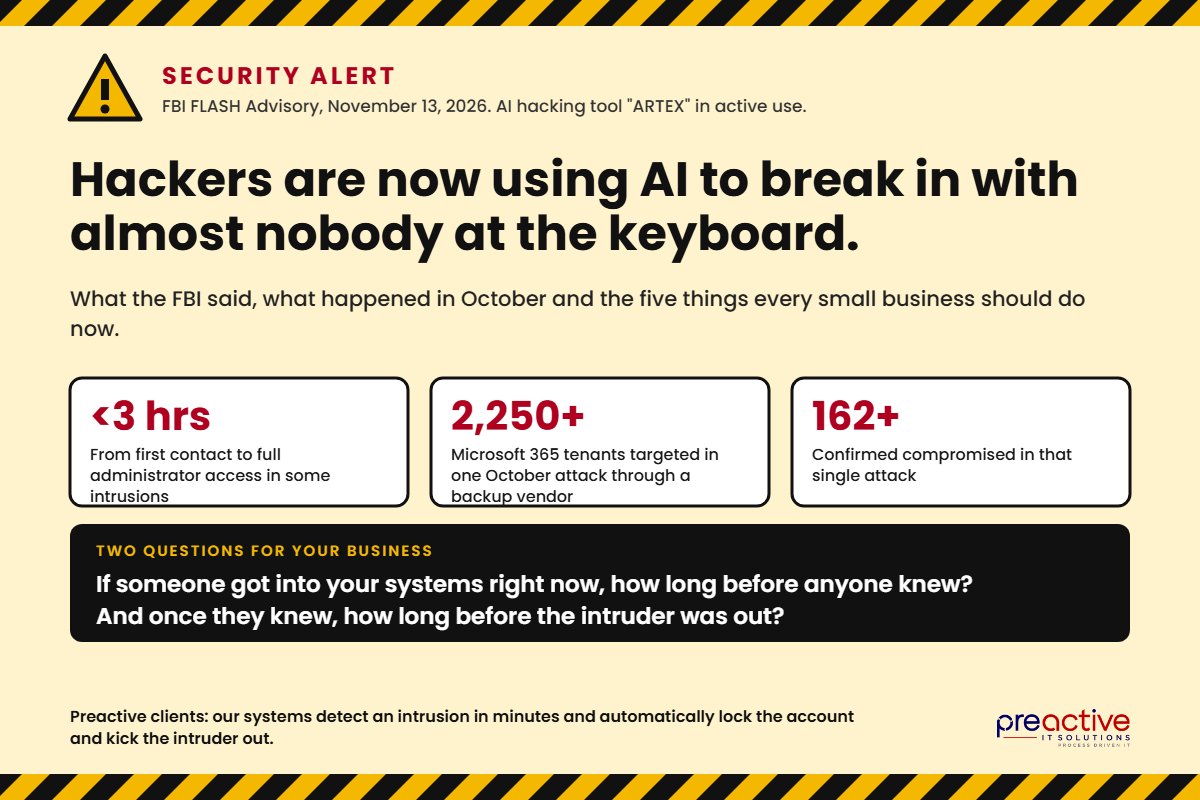
What is ARTEX and why did the FBI issue a warning?
ARTEX is a free, open-source hacking framework that uses AI to run a cyberattack from start to finish with almost nobody at the keyboard. An attacker types one goal, such as “get administrator access to this company,” and ARTEX hands it to a chain of AI agents that scan the target, find a way in, grab higher-level access and steal data on their own. On November 13, 2026 the FBI issued a FLASH advisory (FLASH-20261113-001) because, in its words, “a variety of malicious cyber actors” have been using ARTEX against real companies since at least August. The FBI’s headline number: some intrusions went from first contact to administrator-level access in under three hours. For a Houston construction or engineering firm with 40 to 250 users, the practical question is not whether you are a target. Attackers point ARTEX at whatever is exposed, and it does not care how big you are. The question is whether anyone would notice in time.
I run an IT company and I have been getting this question all week, partly because the advisory landed in the same week as the Microsoft 365, Workday and FAA outages. So here is what the FBI actually said, what happened in the one big attack we know about, whether the outages are connected (they are not) and the five things any small business should do about it, in plain language, no matter whose firewall or server you own.
What did the FBI actually say about ARTEX?
The FBI’s advisory is about a tool, not a country or a gang. The facts it lays out, plus what security researchers have added, come down to this:
- It is free and it is still out there. A developer using the name “Autumn-27” posted ARTEX on GitHub in July 2026 as a “penetration testing” tool. The developer took it down on October 8 after reports it was being abused. Copies, forks and a paid version called ARTEX PRO are still circulating.
- It has no brain of its own. ARTEX plugs into commercial AI models. The FBI says the attacker-run copies it has seen most often use Chinese-developed models.
- Thousands of copies are running. Security researchers counted more than 1,600 ARTEX control panels sitting exposed on the public internet in early November, according to the FBI. The FBI believes the real number is much higher.
- It is fast. The FBI cites Microsoft’s finding that some intrusions reached privileged access in under three hours. Before AI, that step took a human attacker days or weeks.
- Nobody is too small. The FBI lists campaigns against financial services, government, technology, defense, semiconductor, energy, healthcare, manufacturing, telecom and legal firms. A tool that automates the whole break-in does not check your headcount first.
Two things the FBI did not say are worth stating, because the headlines have blurred them. The FBI did not attribute ARTEX to China or any government. It named no state sponsor. And the FBI issued this advisory once, on Friday, November 13. When it went viral on Tuesday the Bureau put out a note that it was “not a new announcement” and that no additional warning had been issued.
How was ARTEX used against Microsoft 365 in October?
The clearest real-world case is the one that should worry any business that runs on Microsoft 365, which is nearly all of them. In October, attackers compromised the application identities behind ConnectWise’s cloud backup product for Microsoft 365, the former SkyKick. Those identities are what the backup software uses to log into a customer’s Microsoft 365 tenant. With them in hand, the attackers used ARTEX to try to log into more than 2,250 customers’ Microsoft 365 accounts. Security firm Huntress confirmed at least 162 of those tenants were actually compromised, some with credential changes and attempts to set up lasting access.
Microsoft published its analysis on October 21 and attributed the attack to a group it tracks as Storm-0940, which it describes as China-aligned. That attribution is Microsoft’s, not the FBI’s.
Why this matters to you: the attackers never touched those 162 companies’ firewalls or guessed anyone’s password. They came in through a vendor’s software that already had the keys. If your IT provider has never shown you a list of which third-party applications have access to your Microsoft 365, you do not know how many sets of keys exist.
Did ARTEX cause this week’s outages?
No. As of this writing, no official source has tied ARTEX to any of the outages that hit the same week. Microsoft said its November 12 to 14 Outlook outage was a network change gone wrong, not a cyberattack. Workday said its November 13 outage was a disaster-recovery test that accidentally connected to production databases. The FAA said its November 13 ground stop traced to a new router its network contractor installed that flooded the air traffic network, and that it has “no indication that this was a cyberattack or an outside nefarious actor.” The Secretary of Homeland Security said the ground stop was not linked to the Microsoft outage. ARTEX is a real threat on its own merits. It does not need the outages to be scary.
What are the five things every small business should do about ARTEX?
These apply whatever brand of firewall, server or workstation you own. Hand this list to your IT provider and ask which ones are done.
- Get every management screen off the public internet. Your firewall’s admin page, remote desktop to any server, the console for your backups, the server that runs your virtual machines and your cloud admin portals should be reachable only through a VPN with multi-factor authentication, or from inside the office. ARTEX’s first move is to scan for exactly these doors. The FBI’s first recommendation is to inventory every internet-facing application you have, including the ones a department set up on its own, and close the ones that do not need to be there.
- Require multi-factor authentication on everything, and split your admin accounts. MFA on email, VPN, remote access and every cloud app, with no exceptions for executives. Then make sure nobody does their daily work from an account that also has administrator rights. A stolen password on a normal account is a bad day. A stolen password on an admin account is the “under three hours” scenario.
- Patch fast and control what can run. ARTEX checks your firewalls, servers and workstations for known holes at machine speed, so a patch you planned to apply next month is a hole this month. Set firewall and server updates on a schedule you actually keep, and use application control on workstations so that only approved software can run. That stops most of what an automated attack tries to install.
- Audit every app that has access to your Microsoft 365. The October attack came in through a vendor’s application identity, not a user. Have your provider pull the list of third-party applications and their permissions in your tenant, remove the ones nobody recognizes, cut the rest down to the least access they need and watch for new ones appearing. The FBI specifically calls out monitoring for new credentials and privilege assignments.
- Have something watching that can act in minutes, around the clock. This is the one that separates “we got lucky” from “we got hit.” Patching and MFA reduce the odds. They do not get to zero. You need monitoring on every account and server that notices an attacker’s first moves, such as a login from somewhere impossible, a new inbox rule or an admin account poking around a server at 2 AM, and that disables the account and kills the session automatically, before a person has finished reading the alert. If your current answer is “the alert goes to a mailbox someone checks in the morning,” that is a nine-hour head start for a tool that needs three.
And one more that is not about ARTEX but is about every attack: keep a tested backup of your servers and your Microsoft 365 that an attacker with admin rights cannot delete. If everything else fails, that is the difference between a bad week and a closed business.
What should you ask your IT provider this week?
Two questions. Write down the answers.
- If someone got into our systems right now, how long before anyone knew?
- Once they knew, how long before the intruder was actually out?
For most small firms the honest answers are “days” and “when the IT guy gets to it.” IBM’s 2026 Cost of a Data Breach report puts the global average at 247 days to identify and contain a breach. At Preactive IT Solutions the answers are minutes and minutes. Our 24/7 security operations service watches every client account and server, and when something looks wrong it locks the account and kicks the intruder out on its own, then tells our team. We have watched it work on a real attack: an attacker got hold of an administrator account, logged into a server and started looking around the network to see what was there. That looking is what tripped the alarm. Within minutes the account was locked and the session was dead. The client heard about it from us, not from a ransom note.
If your provider’s answer to “how fast” involves a phone call and a ticket, that is the gap ARTEX is built to drive through.
Frequently asked questions
What is ARTEX?
ARTEX is a free, open-source “autonomous penetration testing” framework, released on GitHub in July 2026, that uses AI agents to automate a cyberattack from scanning to break-in to data theft with minimal human involvement. The developer took it off GitHub on October 8, 2026, but forks and a paid version remain in circulation. The FBI issued a FLASH advisory about it on November 13, 2026.
Is ARTEX a virus or malware?
No. ARTEX is not something that infects your computer. It is a tool an attacker runs on their own server that plugs into commercial AI models and directs them to attack a target. You cannot “catch” it. You defend against it the same way you defend against a skilled human attacker, only faster.
Did the FBI say China is behind ARTEX?
No. The FBI’s advisory says “a variety of malicious cyber actors” are using ARTEX and names no state sponsor. Separately, Microsoft attributed the October attack on a Microsoft 365 backup vendor to a group it calls Storm-0940, which Microsoft describes as China-aligned. The tool’s original developer also appears to be based in China. Those are different claims from different sources.
Are small businesses really at risk from ARTEX?
Yes. Attackers use ARTEX to go after whatever weakness is exposed, not just big names, so a 50-person engineering firm with an exposed remote desktop server is as likely to be hit as a bank. The FBI’s list of targeted sectors includes manufacturing, energy, legal and healthcare, which are full of small firms.
Can a firewall stop ARTEX?
A firewall helps, but only if its own admin page is not exposed to the internet and it is patched. ARTEX looks for exposed management screens, unpatched devices and stolen credentials. A firewall does nothing about a password phished from an employee or a vendor application that already has access to your Microsoft 365. You need MFA, patching, application control and 24/7 monitoring that acts automatically, not a firewall alone.
How fast should an intrusion be detected and stopped?
Minutes, not days. The FBI says ARTEX intrusions have reached administrator access in under three hours, and the 2026 industry average to identify and contain a breach is 247 days. Monitoring that automatically disables a compromised account and ends the attacker’s session within minutes of the first suspicious action is the standard a small business should ask its IT provider to meet.
About Preactive IT Solutions
Preactive IT Solutions is a Houston managed IT services provider specializing in construction and engineering firms, serving Texas businesses since 2003. We support organizations of 40 to 250 users with a 24/7 help desk staffed by our own technicians, 24/7 security monitoring that acts automatically and an average client relationship of more than eight years. See what is included in managed IT services, the full managed IT services in Houston offering or ask us the two questions.
Sources
- FBI on X, November 17, 2026: confirms the ARTEX advisory was released November 13 and that no additional warning has been issued.
- FBI San Diego on X: “a variety of malicious cyber actors have used ARTEX” since at least August 2026.
- SafeBreach, summary of FBI FLASH-20261113-001: tool details, targeted sectors, 1,600+ exposed consoles, under-three-hours figure, recommended mitigations.
- BleepingComputer, “FBI warns ARTEX AI hacking tool is powering global cyberattacks”.
- Newsweek, “What Is ARTEX? What to Know About FBI’s Recent AI Warning”: GitHub release and removal dates.
- Cybersecurity Dive, October 22, 2026: Microsoft’s attribution of the ConnectWise cloud backup attack to Storm-0940 and its use of ARTEX.
- BleepingComputer, “Hackers breach Microsoft 365 tenants via ConnectWise supply chain attack,” October 17, 2026: 2,250+ tenants targeted; Huntress confirmed at least 162 compromised.
- Fox News live coverage, November 17, 2026: officials state cyberattacks were not behind the week’s outages.
- WindowsForum, “Outlook, Workday and FAA outages: what the evidence says about a shared cause”: stated causes for each outage.
- IBM Cost of a Data Breach Report 2026: 247-day global average to identify and contain a breach.